

Bantam
Black
Cochin
Cochins became popular in the nineteenth century during the enthusiasm for Asian poultry and have remained distinctive ornamental exhibition chickens.
Cochin bantams combine the same rounded body, soft feathering and heavy foot feathering as their large-fowl counterparts.
Extended Black base (E/E)
Feathered shanks (Pti/-)
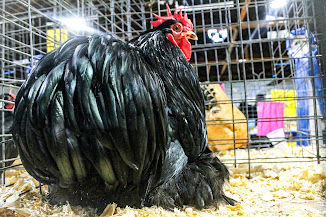

What this bird looks like
Glossy black feathers across most of the body, often with a green sheen in sunlight. [1]
How these genes work together
Extended Black makes the body and leg feathers glossy black, while Ptilopody causes feathers to grow down the legs and toes. Correct black color and correct Cochin foot feathering require separate selection. [9]
MC1R studies help establish the dark Extension background, while also showing why color and breed type should not be treated as the same inherited trait. [9]
Compare this with Black Rosecomb. Both varieties include Extended Black in their working formulas, but here Ptilopody adds feathered legs, whereas Rose Comb in the other variety makes a broad rose comb.
What each gene does
Extended Black
The starting coat is black; Blue, Lavender, Chocolate or White may change or hide it. The E allele at the Extension/MC1R locus favors widespread black pigment production, giving a black or nearly black feather background. It is the starting pigment pattern, not a guarantee that every feather will be uniformly black: leakage and additional modifiers can still matter. [5] [6]
Ptilopody
This grows feathers down the shanks and toes. Ptilopody describes feather growth down the shanks and sometimes onto the toes. It changes limb feather distribution rather than pigment chemistry, and multiple regulatory backgrounds involving limb-development genes have been described. [7] [8]
1. American Poultry Association accepted varieties
2. Oklahoma State University poultry breed histories
3. Fulton, J. E., McCarron, A. M., Mullen, A., Ali, L., and Tarrant, K. J. (2025). A review of genetic variation underlying chicken phenotypic diversity. Poultry Science 104(11):105761. https://doi.org/10.1016/j.psj.2025.105761
4. Chen, C.-F. and colleagues. (2018). Genetic and Molecular Basis of Feather Diversity in Birds. Genome Biology and Evolution 10(10):2572–2586. https://pmc.ncbi.nlm.nih.gov/articles/PMC6171735/
5. Kerje, Susanne, et al. "Melanocortin 1‐receptor (MC1R) mutations are associated with plumage colour in chicken." Animal genetics 34.4 (2003): 241-248.
6. Shoffner, R. N., J. S. Otis, and V. A. Garwood. "Association of dominant marker traits and metric traits in chickens." Poultry science 72.8 (1993): 1405-1410.
7. Du, Wenya, et al. "Identification of genes involved in regulating the development of feathered feet in chicken embryo." Poultry Science 102.9 (2023): 102837.
8. Bortoluzzi, Chiara, et al. "Parallel genetic origin of foot feathering in birds." Molecular biology and evolution 37.9 (2020): 2465-2476.
Kerje, S., et al. (2003). MC1R mutations are associated with plumage colour in chicken. Animal Genetics 34:241–248. https://doi.org/10.1046/j.1365-2052.2003.00991.x